Depicting a Monarch Butterfly Vector Art: Merging Botanical Watercolor with Scalable Design
The Intersection of Organic Texture and Digital Precision
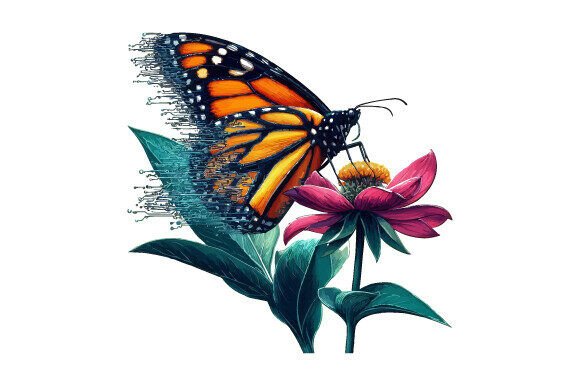
In the realm of digital illustration, achieving a balance between natural imperfection and technical scalability is a persistent challenge for designers. When depicting a monarch butterfly vector art, the goal is often to retain the ethereal, translucent quality of traditional media while ensuring the file remains functional across various commercial applications. This specific botanical watercolor illustration exemplifies that hybrid approach. Unlike standard flat vector graphics that can sometimes appear sterile or overly geometric, this composition utilizes simulated watercolor textures within a vector environment. The result is an image where the iconic wings—rendered in burnt orange, deep ebony, and soft ivory—maintain the visual weight of stained glass without losing the infinite resize capability inherent to formats like AI, EPS, and SVG.
The technical achievement here lies in the treatment of the wing veins and surrounding flora. While the overall aesthetic suggests a hand-painted origin with wispy foliage and dreamy softness, the underlying structure relies on precise vector strokes. This duality allows the artwork to serve dual purposes: it functions as high-resolution wall art when printed at large scales due to its 300 DPI CMYK color profile, yet it remains crisp and editable when scaled down for business cards or web icons. For professionals and hobbyists alike, understanding how this fusion works is key to selecting assets that do not sacrifice artistic integrity for utility.
Color Theory and Biological Accuracy in Illustration
Effective nature illustration requires more than just aesthetic appeal; it demands a respect for biological reality. When depicting a monarch butterfly vector art, color accuracy plays a significant role in the viewer's connection to the piece. The monarch (Danaus plexippus) is defined by its warning coloration, a biological signal known as aposematism. In this botanical watercolor illustration, the vibrant shades of burnt orange are not merely decorative but representative of this natural defense mechanism. However, the artistic interpretation softens these bold tones with translucent washes, making the image suitable for serene contexts like stationery or eco-conscious branding where aggressive contrast might be jarring.
The supporting palette of muted greens and blush tones found in the milkweed, lavender, or eucalyptus backdrop serves a critical compositional function. These cooler, desaturated hues provide necessary negative space and visual rest, allowing the warm spectrum of the butterfly to take center stage without overwhelming the viewer. From a design workflow perspective, having these colors separated or easily adjustable in CMYK mode is essential. A designer creating packaging for a tea brand may need to shift the background foliage toward sage green to match a label, while a wedding stationer might adjust the blush tones to coordinate with a specific floral arrangement. The inclusion of editable color layers transforms a static illustration into a dynamic design component.
Technical Specifications for Professional Workflows
For researchers, educators, and commercial designers, the file architecture is as important as the visual content. This asset package is engineered for compatibility and longevity within professional creative suites. The provision of files ready for CS6 ensures backward compatibility for users who have not upgraded to the latest Creative Cloud subscriptions, while still maintaining full fidelity in newer versions. Understanding the specific utility of each included format is crucial for maximizing the asset's value.
- AI (Adobe Illustrator): The native source file containing all editable paths, layers, and text objects. This is the primary workspace for customization, allowing users to isolate the butterfly from the background or alter individual petal shapes.
- EPS (Encapsulated PostScript): A universal vector format compatible with CorelDRAW, Affinity Designer, and older versions of Illustrator. It serves as the industry standard for transferring vector data between different software ecosystems.
- SVG (Scalable Vector Graphics): Essential for web deployment. Unlike raster images, this format keeps the monarch butterfly sharp on retina displays and responsive websites while keeping file sizes minimal compared to high-res PNGs.
- PDF (Portable Document Format): Optimized for print-ready output. This format embeds the CMYK color profile and 300 DPI resolution settings, ensuring that what is seen on screen matches the physical proof from a commercial printer.
- JPEG and PNG: Rasterized exports provided for immediate use in non-vector environments, such as presentation slides, social media posts, or draft mockups where editing is not required.
The 300 DPI resolution specification applies specifically to the raster components and the intended print size of the vector art. While vectors themselves are resolution-independent, any embedded textures or exported previews must meet this threshold to avoid pixelation in physical media. This distinction is vital for print production managers who must verify asset quality before sending jobs to press.
Practical Applications Across Industries
The versatility of depicting a monarch butterfly vector art extends far beyond generic decoration. Different sectors leverage this type of botanical watercolor illustration to communicate specific values and narratives. In the educational sector, accurate yet aesthetically pleasing depictions of pollinators are invaluable for textbooks, museum signage, and classroom posters. The vector nature allows educators to zoom in on wing vein structures or milkweed interactions without loss of detail, facilitating closer study of entomology and botany.
For the sustainable goods market, this imagery supports eco-conscious branding initiatives. Brands focusing on organic skincare, fair-trade coffee, or environmental conservation often utilize nature-inspired motifs to signal their commitment to biodiversity. The delicate fusion of nature and artistry in this illustration avoids the cliché of stock photography, offering a bespoke feel that resonates with consumers seeking authenticity. The ability to customize the color palette means a honey producer can emphasize golden yellows, while a lavender farm can enhance the purple accents, all using the same foundational artwork.
In the stationery and paper goods industry, the "quiet poetry of pollinators" described in the artwork’s concept translates directly to product appeal. Wedding invitations, greeting cards, and journals benefit from the serene composition. Because the file is fully editable, designers can rearrange elements to fit various aspect ratios—moving the wildflowers to create a border pattern or isolating the butterfly for a central focal point. This adaptability reduces the need to commission multiple custom illustrations, streamlining the product development cycle for small businesses and independent creators.
Customization and Editability Considerations
Acquiring a vector asset is only the first step; realizing its potential requires understanding customization workflows. When working with this monarch butterfly botanical watercolor illustration, users should approach editing with an awareness of the hybrid technique used. Since the watercolor effects are likely achieved through complex gradients, opacity masks, or textured brushes applied to vector paths, simple fill color changes may not always yield the desired result. Instead, utilizing global swatches or recolor artwork tools within Adobe Illustrator offers a more harmonious way to shift the overall mood without breaking the texture simulation.
Furthermore, the separation of elements is a key advantage. If the intention is to use the butterfly for a logo, the surrounding flora can be hidden or deleted entirely. Conversely, if the goal is to create a seamless pattern for textile printing, multiple instances of the flora and butterfly can be duplicated and arranged using the vector anchor points as guides. The fine vector strokes outlining the wing veins remain distinct even when colors are dramatically altered, preserving the definition that gives the piece its structural integrity. This level of control distinguishes premium vector art from flattened raster images, empowering users to tailor the depiction of monarch butterfly vector art to exact project specifications.
The Role of Pollinator Imagery in Visual Communication
Beyond technical specs and commercial utility, there is a cultural significance to choosing this specific subject matter. Monarch butterflies are currently facing population declines due to habitat loss and climate change, making them a potent symbol for environmental stewardship. Utilizing art that depicts them in mid-rest among native wildflowers subtly educates the audience about their ecological needs. The inclusion of milkweed in the composition is particularly relevant, as it is the sole host plant for monarch caterpillars. By selecting illustrations that accurately pair the insect with its habitat, designers and communicators contribute to a broader narrative of conservation.
This emotional resonance enhances the effectiveness of the visual communication. Whether used on a donation form for a wildlife charity or as the cover of a nature journal, the image evokes a sense of fragility and resilience. The dreamy softness of the watercolor style invites contemplation rather than demanding attention, aligning perfectly with messages of mindfulness, sustainability, and appreciation for the natural world. In this way, the technical attributes of the file support a deeper storytelling objective, proving that functional design assets can also carry profound meaning.