Family Standing in Front of House Line a: Integrating Vector Assets into Visual Workflows
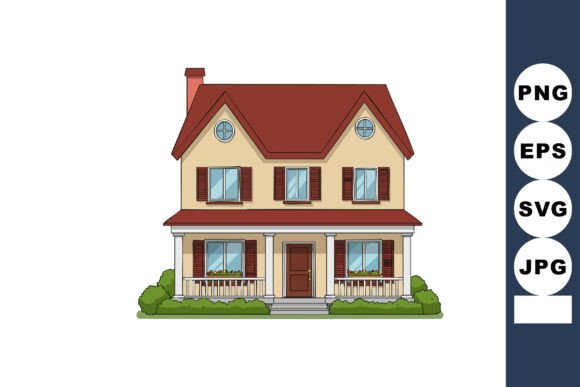
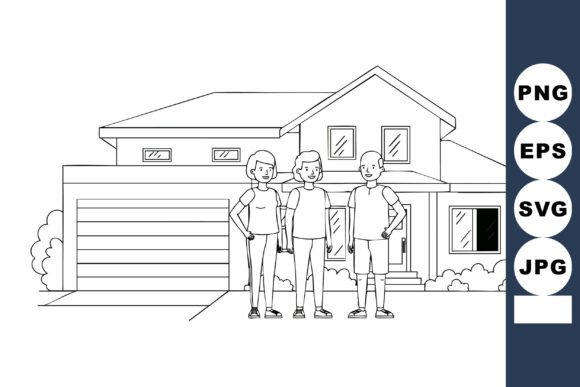
In the realm of digital design and content creation, specific visual assets often serve as foundational elements for broader communication strategies. The Family Standing in Front of House Line a vector illustration is one such asset, depicting a family of three positioned before a residential structure complete with a garage and landscaping. While visually simple, this line art representation functions as a versatile component within professional workflows ranging from real estate marketing to educational curriculum development. Understanding how to leverage this specific graphic involves more than just placing an image on a canvas; it requires a strategic approach to file management, technical compatibility, and contextual application.
This vector line art presents a calm homeownership concept that avoids the visual noise often associated with photorealistic stock imagery. For professionals aged 20 to 50, including marketers, educators, and small business owners, this aesthetic aligns with modern design trends that prioritize clarity and scalability. The downloadable ZIP package containing SVG, EPS, JPG, and PNG formats ensures that the asset can transition seamlessly between high-resolution print production and responsive web environments. Integrating this resource effectively means understanding where it fits in the project lifecycle and how to maintain consistency across various media touchpoints.
Strategic Application Across Project Phases
The utility of the Family Standing in Front of House Line a extends throughout the entire lifespan of a creative or business project. It is not merely a final decorative element but a tool that supports decision-making and messaging at multiple stages.
Pre-Project Planning and Concept Validation
During the initial planning phases of a website build, brochure design, or presentation, stakeholders often struggle to visualize abstract concepts like "stability," "family security," or "property ownership." Using this line art during wireframing or mood boarding provides an immediate visual anchor. Because it is a vector-based line drawing, it does not distract from layout discussions with color or texture. This allows teams to focus on information architecture and user flow. For entrepreneurs pitching a new housing-related service, this graphic serves as a low-fidelity prototype element that communicates the core value proposition without requiring expensive custom illustration or photography budgets early in the validation process.
Active Production and Content Creation
Once a project moves into active production, the multi-format nature of the ZIP file becomes critical. Designers working in Adobe Illustrator or Affinity Designer will utilize the EPS or SVG files to modify stroke weights, adjust colors to match brand guidelines, or isolate specific elements like the house or the family figures. Conversely, content managers updating a WordPress site or creating social media graphics in Canva may rely on the PNG or JPG versions for quick implementation. The calm demeanor of the illustration makes it particularly effective for sensitive topics such as mortgage counseling, insurance education, or family financial planning, where aggressive sales visuals might alienate the audience.
Post-Launch Optimization and Repurposing
After a campaign launches, assets must often be repurposed for different channels. A vector asset like Family Standing in Front of House Line a offers longevity that raster images cannot match. If a billboard campaign needs to be scaled down to a business card, or if a web banner needs to be animated for video, the source vector file retains perfect fidelity. This reduces the need to commission new variations of the same concept, streamlining long-term asset management and ensuring visual consistency across years of marketing efforts.
Technical Integration and File Management
Efficient workflow depends heavily on how digital assets are organized and deployed. The inclusion of four distinct file types in the downloadable ZIP addresses specific technical requirements, but users must understand the appropriate context for each to maintain quality and efficiency.
- SVG (Scalable Vector Graphics): Essential for web development. This format allows the illustration to scale infinitely on any screen size without pixelation. Developers can also manipulate SVG code directly with CSS to create hover effects or animations, making the static line art interactive.
- EPS (Encapsulated PostScript): The industry standard for professional printing and advanced vector editing. Use this file when sending materials to commercial printers or when extensive modification is required in legacy vector software.
- PNG (Portable Network Graphics): Ideal for digital documents, presentations, and web use where transparency is needed. Unlike JPG, PNG preserves the clean edges of line art against varied backgrounds without compression artifacts.
- JPG (Joint Photographic Experts Group): Best reserved for scenarios where file size is the primary constraint and transparency is unnecessary, such as email newsletters or basic document embedding.
Proper organization begins immediately upon download. Rather than leaving files in a generic "Downloads" folder, integrate them into a structured Digital Asset Management (DAM) system or a standardized project directory. Renaming files to include descriptive metadata—such as homeownership-family-lineart-v1.svg—improves searchability for future team members. For agencies managing multiple clients, maintaining a master library of these base vectors prevents redundant purchases and ensures that all designers are accessing the highest quality source files rather than degraded screenshots.
Workflow Compatibility and Tool Interaction
The Family Standing in Front of House Line a asset is designed to interact smoothly with standard creative and productivity ecosystems. Its compatibility spans across three primary categories of tools used by modern professionals.
Professional Design Software
For users in Adobe Creative Cloud, CorelDRAW, or Affinity suites, the vector files act as native objects. This interoperability allows for non-destructive editing. A marketer can open the EPS file, change the line color from black to a brand-specific navy blue, and export a web-ready SVG in minutes. This flexibility is crucial for maintaining brand identity while using stock-style assets. The line art style specifically reduces processing overhead compared to complex gradients or meshes, making it performant even in large-scale layout files.
No-Code and Low-Code Platforms
Not every user is a professional designer. For bloggers, educators, and small business owners utilizing platforms like Squarespace, Wix, Shopify, or Notion, the PNG and SVG formats provide plug-and-play functionality. These platforms often have built-in image editors that can handle basic cropping or filtering. Because the illustration features a clean, minimalist aesthetic, it integrates well with template-based designs without clashing with pre-existing themes. This democratizes access to professional-grade visuals for users who lack advanced design training.
Document and Presentation Suites
In corporate and educational settings, this asset frequently appears in PowerPoint, Keynote, Google Slides, and PDF reports. Here, the calm presentation of the family and house supports narrative storytelling. When embedded in these tools, the vector formats ensure that slides look crisp on high-DPI projectors and printed handouts alike. Users should avoid stretching raster versions in these applications; instead, inserting the original vector or high-resolution PNG maintains professional polish during client-facing presentations.
Practical Implementation Tips for Consistency
To maximize the return on investment for this asset, users should adopt specific best practices regarding preparation, usability, and quality control. These observations stem from common pitfalls encountered when integrating line art into mixed-media projects.
Maintain Stroke Integrity: When scaling vector line art, be mindful of stroke width. Enlarging the Family Standing in Front of House Line a significantly may result in lines appearing too thin relative to the overall composition. Most vector software allows for "Scale Strokes & Effects" toggles; keeping this enabled ensures the visual weight remains consistent regardless of size.
Contextual Color Adaptation: While the default black line art is neutral, adapting the color to match the surrounding environment improves cohesion. For dark mode websites, invert the lines to white or light gray. For printed materials on colored paper, consider using a spot color or white ink. This simple adjustment transforms a generic stock asset into a bespoke design element.
Accessibility Considerations: When deploying this image on the web or in digital documents, always include descriptive alt text. Screen readers cannot interpret line art, so providing context such as "Line drawing illustration of a family of three standing calmly in front of a house with garage and bushes representing homeownership" ensures inclusivity. This practice also contributes to SEO performance by signaling relevance to search engines.
Licensing and Usage Rights: Always verify the specific license terms included in the ZIP file before commercial deployment. Understanding whether the asset allows for unlimited reproduction, modification, or resale protects businesses from legal complications. Keeping a record of the purchase receipt and license agreement within the project folder is a recommended administrative habit.
Evaluating Quality and Long-Term Value
The decision to use Family Standing in Front of House Line a should be weighed against project goals. Line art offers distinct advantages over photography in specific contexts: it loads faster on websites, prints cheaper in single-color formats, and ages better because it lacks dated fashion or architectural details. However, it may not convey the emotional warmth of a photograph for certain luxury real estate listings. Professionals must assess whether the "calm concept" aligns with their specific messaging objectives.
For productivity-minded users, the value lies in the asset's reusability. By establishing a workflow that treats this vector as a modular component rather than a disposable image, organizations can build a cohesive visual language over time. The combination of SVG, EPS, JPG, and PNG formats in a single ZIP eliminates friction points between departments, allowing marketing, web, and print teams to operate from a single source of truth. Ultimately, successful integration is measured not just by the aesthetic appeal of the final output, but by the efficiency of the process used to achieve it.